REVIEW · PRAGUE
Private Prague Art Nouveau and Cubism Walking Tour
Book on Viator →Operated by Insight Cities · Bookable on Viator
Prague shifts gears around 1900, and this tour helps you see that change up close. You get a private walking tour focused on Art Nouveau and Cubist design, not the usual postcard stops. I especially like how the guide points out specific details you’d miss on your own, like the curvy typography and the oriental flavor some façades borrow.
The second thing I like: you’re traveling with a historian guide who turns buildings into stories you can use while you explore the city afterward. The only real drawback is simple: this is about 3 hours of walking, and it’s not a good fit if you have mobility limits.
In This Review
- Key Highlights You’ll Actually Notice
- Art Nouveau Meets Cubism: A Prague You Can Read
- Price and Value for a Up-to-10 Private Group
- Timing, Pace, and Meeting Point Reality
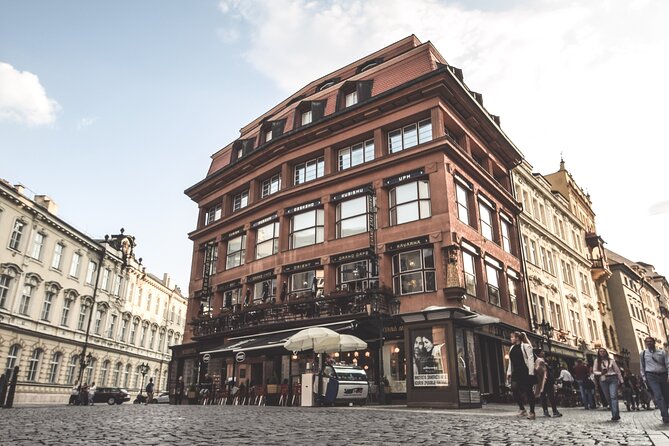
- Stop 1: House of the Black Madonna and the Cubist Start
- Stop 2: Obecni Dum and the Feel of Czech Art Nouveau
- Stop 3: K+K Hotel Central Prague and an Early Art Nouveau Moment
- Stop 4: Café Imperial and Art Nouveau Indoors
- Stop 5: Czechoslovak Legion Bank and Cubism with a Cause
- Stop 6: Prague Main Train Station and an Art Nouveau Dome
- Stop 7: Wenceslas Square and Art Nouveau Meets Art Deco
- Stop 8: Lucerna Arcade and Prague’s Interior Arcades
- Stop 9: The Upside-Down Statue and the Czech National Revival Story
- Why the Guide Quality Matters on This Kind of Tour
- Who This Tour Best Fits
- Should You Book This Private Prague Art Nouveau and Cubism Tour?
- FAQ
- How long is the Private Prague Art Nouveau and Cubism Walking Tour?
- Is this tour private, and how large is the group?
- What language is the tour offered in?
- Where do I meet the guide?
- Are there admission tickets included for the stops?
- Is food or drinks included?
- What is the cancellation policy?
Key Highlights You’ll Actually Notice
- Cubist and Art Nouveau in one focused loop, so you see the contrast instead of guessing at it later
- A historian guide who ties design choices to what Prague felt like during the early-1900s optimism
- Admission-free stops, including major interiors you can look at without extra ticket errands
- Specific visual cues, from ornamental lighting and signage styles to oriental-influenced motifs
- Czech identity in the details, including World War I commemoration and Czech National Revival symbolism
Art Nouveau Meets Cubism: A Prague You Can Read
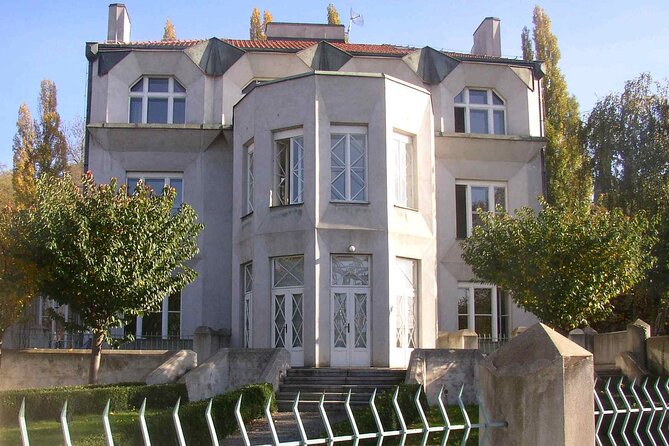
Prague is famous for older styles, like Gothic and Renaissance, but the turn-of-the-20th-century wave is where the city starts feeling modern. On this walk, you’re not just looking at pretty façades. You learn how artists and architects tried to shape everyday life through design, from signs and fixtures to whole building rhythms.
You’ll also see how quickly taste changed. In a short span, Cubism’s angular attitude shows up beside Art Nouveau’s flowing curves and decorative swagger. That makes this tour useful even if you only have a day or two in Prague, because it gives you a way to spot what you’re seeing as you move through the city afterward.
The guide’s job is to help you notice. You’ll be asked to look at patterns, symbols, and materials like they matter, because they did. And they still do.
You can also read our reviews of more walking tours in Prague

Price and Value for a Up-to-10 Private Group
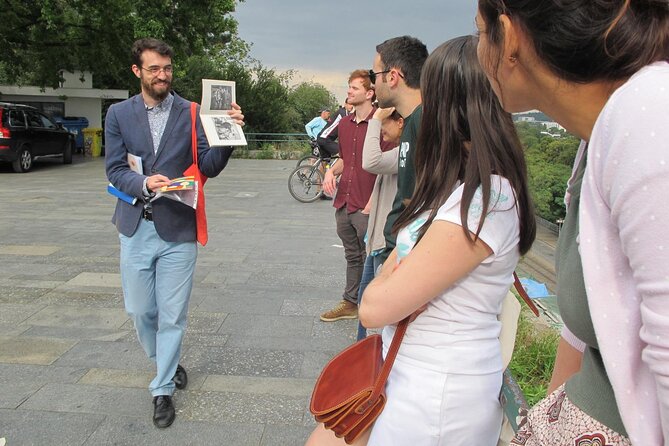
This private tour costs $396.46 per group for up to 10 people, lasting about 3 hours. That price can feel steep if you’re thinking per-person like a bus tour, but it’s not designed that way. It’s priced so a group of friends or a small family can share the cost, and you get a real back-and-forth with your guide.
Here’s how I’d think about value. You’re paying for three things: a historian’s time, a tightly planned route through places you’d otherwise skim, and commentary that connects architecture to culture and history. If you’re the type who likes to pause and look, this format pays off fast.
If you’re traveling solo or as a couple, it might be less of a bargain. But Prague’s Art Nouveau and Cubism isn’t something you can easily “self-guide” without some context. A guide helps you avoid that trap where you see buildings but don’t understand what you’re seeing.
Also worth noting: this tends to be booked around 8 days in advance, so you’ll want to lock in your preferred time window sooner rather than later.
Timing, Pace, and Meeting Point Reality
The tour runs about 3 hours, and it’s built around short stops with quick orientation. You’ll likely spend more time walking between points than you expect, even though each location is only a few minutes. In plain terms: bring comfortable shoes and be ready to keep moving.
On logistics, pickup can be offered, but the standard setup is that you meet your guide 15 minutes early at Grand Cafe Orient, Ovocný trh 19, Prague 1, unless hotel pickup has been arranged. You’ll also be close to public transportation, which helps if you’re coordinating with another day plan.
You can choose morning or afternoon departures when you book. That’s handy if you want this early to set your architecture radar for the rest of your trip, or later so you can pair it with evening plans.
Stop 1: House of the Black Madonna and the Cubist Start
You begin at the House of the Black Madonna, a distinctive building in Cubist style. The point of the first stop is to set your visual baseline. Cubism isn’t just a style for painters; it influences how façades feel, how edges and volumes behave, and how the whole structure reads from the street.
A good guide will help you look at the building like a composed image, not just an exterior. If you’ve never trained your eye this way, this first stop is where the tour starts paying dividends. You’ll be practicing the same “look closely, then connect the dots” method for the rest of the walk.
This stop is short, about 10 minutes, and the admission is listed as free. That means you’re not losing time hunting tickets. You’re also not stuck in a long queue or an indoor program.
Stop 2: Obecni Dum and the Feel of Czech Art Nouveau
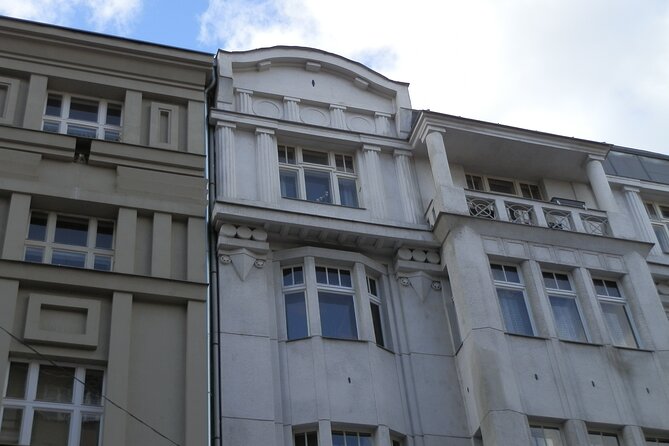
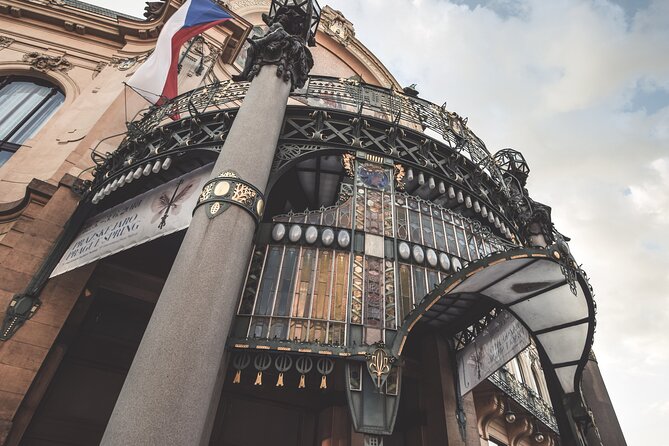
Next is Obecní dům, one of the best-known markers of Czech Art Nouveau. This is where you start noticing the signature language of Art Nouveau: decorative linework, a sense of motion, and details that look like they belong to posters and magazines of the era.
Art Nouveau often feels like it’s trying to make everyday life look more human. The guide will likely point you toward design elements that show that intent, and you’ll start to connect Prague’s architecture to the wider visual culture happening around 1900.
This stop is about 15 minutes and is also admission-free on the tour plan. It’s a good place to slow down briefly and take photos from a couple angles, because Art Nouveau details can look different when the light hits or when you move a step.
You can also read our reviews of more private tours in Prague





Stop 3: K+K Hotel Central Prague and an Early Art Nouveau Moment
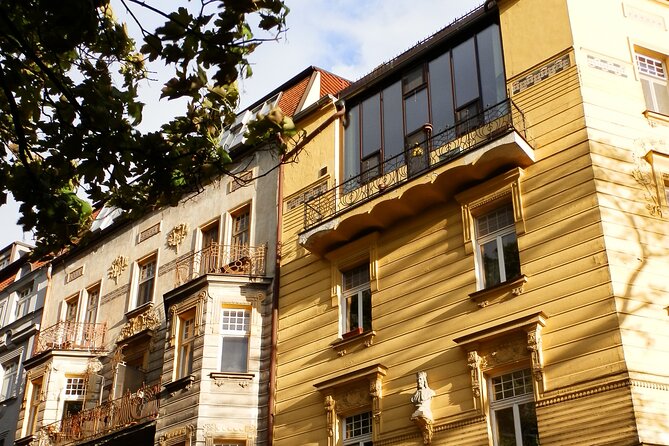
At the K+K Hotel Central Prague, you’ll see what the tour frames as the first Art Nouveau building in Prague. That label matters. It tells you you’re not just catching an example of a style. You’re standing in the early stage of a major shift in how Prague presented itself.
This is around 10 minutes, with free admission. Even if you only glimpse part of the building’s exterior character, it’s enough to give you something concrete to compare later. When you move toward interiors on the next stops, you’ll already know what the exterior “grammar” looks like.
Stop 4: Café Imperial and Art Nouveau Indoors
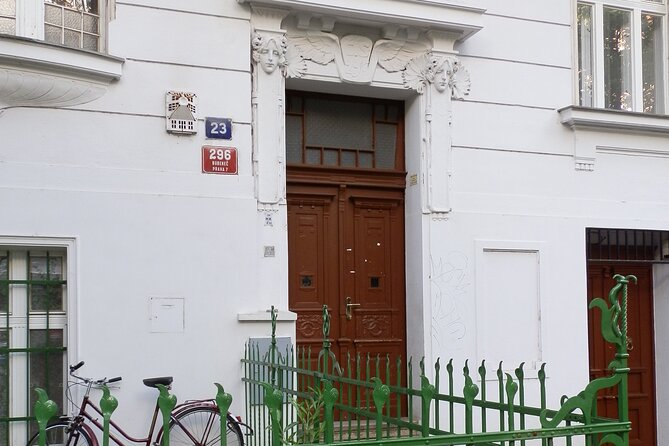
Then the tour moves to Café Imperial, focusing on a unique Art Nouveau interior. This is a key moment because Art Nouveau isn’t limited to street-level façades. The style was meant to wrap around you, guiding how a room feels as much as how it looks.
The stop is short, about 5 minutes, so use it for quick observation: look up, look along edges, and check how decorative elements repeat. A good guide will steer you toward what to notice so you don’t just snap a photo and move on.
Even though the time is brief, indoor moments like this help you understand why people fell for the style in the first place. It’s not just a look outside. It’s a mood.
Stop 5: Czechoslovak Legion Bank and Cubism with a Cause
Now you shift from aesthetics to meaning at the Czechoslovak Legion Bank. The tour spotlights its Cubist architecture and interior, plus the fact that it’s dedicated to the Czechoslovak Legion of the 1st World War.
This is where the architecture becomes a message. You’ll be thinking about design as public memory, not only art for art’s sake. If you want to understand Prague beyond dates and monuments, this is the kind of stop that explains why certain buildings feel emotionally loaded even if they’re “just” architectural landmarks.
The time here is about 10 minutes, and admission is listed as free. The drawback is timing: you won’t have hours. The upside is that you’ll get the story and the symbolism without turning it into a long museum detour.
Stop 6: Prague Main Train Station and an Art Nouveau Dome
At Praha hlavní nadrazi, you’ll see the station’s magnificent interior Art Nouveau dome. This is one of those places where architecture and daily life overlap. People come through without realizing they’re walking under a major design statement.
The stop is about 15 minutes, and it’s admission-free as part of this tour plan. That longer time is smart: a dome needs space to be appreciated. When you’re under it, look for how the interior shape changes your sense of scale, and notice how decorative style can soften a transit hub that could otherwise feel purely functional.
If you like practical architecture—design that you experience while doing normal life—this stop is a strong payoff.
Stop 7: Wenceslas Square and Art Nouveau Meets Art Deco
Next up is Wenceslas Square, where the guide discusses the square’s Art Nouveau and Art Deco architecture. This part of the walk helps you see the transition of styles in real time. Even if you don’t recognize every façade style instantly, the guide’s framing helps you understand the timeline of taste.
This stop is about 15 minutes and is admission-free. You’ll likely get a quick lesson on how these styles relate—what’s similar, what changes, and how Czech identity and modern ambition show up in street-level design.
Also, it’s a useful reset point. Wenceslas Square is a busy area, so you’re better off staying focused on your guide’s cues instead of getting pulled into random side streets. Think of it as a classroom where the walls keep moving.
Stop 8: Lucerna Arcade and Prague’s Interior Arcades
Then you head to Lucerna Arcade, with time to view the Art Nouveau interior of the arcades. The tour description frames it as among the most beautiful arcades of Prague, and that fits the general idea of the style: decorative work made for walking, lingering, and looking.
This stop is about 10 minutes, and admission is listed as free. Because arcades are designed for pace, you can usually slow down and take in details without feeling like you’re standing in the wrong place. The guide can also help you notice how the space is composed, not just decorated.
If you like shopping arcades, cafés, and places where design invites you to stay, you’ll probably wish this stop were longer. But as part of a 3-hour walk, it’s a well-timed breath between heavier history moments.
Stop 9: The Upside-Down Statue and the Czech National Revival Story
The final stop is the Upside-Down Statue of King Wenceslas riding a Dead Horse. This is not just an odd sculpture for a photo. The tour frames it as a symbol you should interpret through Czech history and the Czech National Revival.
This is a different kind of architecture lesson. It’s about ideas and identity expressed in public art. The upside-down concept signals inversion and critique—useful for understanding how Czech culture has repeatedly negotiated political and social change.
The stop is about 10 minutes and admission-free. You’ll want to stay present here. Look at how the sculpture sits in its urban setting, and pay attention to the guide’s explanation of what the symbolism is doing in the broader story.
When you finish, you’ll likely realize something: the tour started as a style walk, but it ends as a cultural one.
Why the Guide Quality Matters on This Kind of Tour
A big reason this tour earns strong ratings is how the guide connects design features to a story you can repeat. One example from the guide roster you may run into is Robert Wesley, described as Czech-born with a Nigerian father, and the way he brings personal history into building stories makes the explanations feel human rather than robotic. Another guide, Bonita, is noted for weaving together history, culture, art, and architecture so the points land clearly.
You don’t have to memorize everything. What you’re really collecting is a new set of attention skills. Once you’ve been trained to notice curves, geometry, symbolism, and influences, Prague’s streets start behaving like a living textbook.
Who This Tour Best Fits
This experience is best for you if you enjoy architecture as a language. You’ll likely like the tour most if you want more than a list of landmarks and you’re the type who stops to look closely at façades, interiors, and symbols.
It’s also a good choice if you’re traveling with a small group. Since it’s private and sized up to 10, you can move with less crowd pressure than group tours.
One caution: it involves a lot of walking and is not suitable for mobility-impaired travelers, based on feedback from the experience.
Should You Book This Private Prague Art Nouveau and Cubism Tour?
If you want Prague that feels less like a checklist and more like a place with ideas, I’d say yes. For a group price up to 10, you’re buying expert interpretation plus a tightly connected route through the city’s late-19th and early-20th-century design world. The fact that stops are listed as admission-free also reduces friction, so your time stays focused on seeing and learning.
Book it especially if you’re the sort of traveler who likes to understand what you’re looking at. If you prefer fast sightseeing from one major monument to the next, or if walking is a problem, you may be happier with a shorter or more accessible option.
If you do book: wear good shoes, choose your departure time to match your energy, and bring a camera or phone you can use without rushing. This tour rewards slow attention, even when the schedule is tight.
FAQ
How long is the Private Prague Art Nouveau and Cubism Walking Tour?
The tour lasts about 3 hours.
Is this tour private, and how large is the group?
Yes, it’s private. Only your group participates, with up to 10 people per group.
What language is the tour offered in?
The tour is offered in English.
Where do I meet the guide?
Unless hotel pickup has been arranged, you meet the guide 15 minutes before the start time at Grand Cafe Orient, Ovocný trh 19 Prague 1.
Are there admission tickets included for the stops?
The listed stops are marked as admission ticket free on the tour plan.
Is food or drinks included?
Food and drinks are not included unless specified.
What is the cancellation policy?
You can cancel for a full refund up to 24 hours in advance of the experience’s start time.