REVIEW · PRAGUE
Prague´s Old Town, Jewish Quarter and Charles Bridge Private Tour
Book on Viator →Operated by Private Prague Guide Day Tours · Bookable on Viator
Old Town Prague feels less like a stamp-collecting tour here. This private walking experience strings together major sights and the stories behind them, with a licensed guide who can slow down or speed up. You also get easy hotel pickup or a meet-up point in the center, which matters when you’re trying to see a lot without wasting time.
I like that the route isn’t just monuments on a map. You’ll hit the Municipal House, the Astronomical Clock show, major Jewish landmarks like the Old-New Synagogue and Pinkas Synagogue, then finish with the Charles Bridge views. One consideration: in about 3 hours, you’ll do plenty of walking and a fair amount of standing—if you hate crowds at the clock, plan for it.
In This Review
- Key things I’d lock in before you go
- Entering Old Town with a guide who actually changes your day
- Municipal House to Powder Tower: Art Nouveau meets the medieval gate
- Cubist House of the Black Madonna and the Estates Theatre: Prague’s art nerd side
- Charles University, Wenceslas Square, and Havel’s Market: history with names and dates
- Old Town Square and the Astronomical Clock’s hourly show
- Jewish Quarter essentials: Old-New Synagogue, Pinkas Synagogue, and Jan Palach
- Klementinum and Charles Bridge: books, towers, and city panoramas
- Price and logistics: is $134.86 per person worth it?
- How to plan your day for the best experience
- Who this private Prague tour is best for
- Should you book the Prague Old Town, Jewish Quarter and Charles Bridge Private Tour?
- FAQ
- Is this tour private?
- How long is the Prague Old Town, Jewish Quarter and Charles Bridge private tour?
- Is hotel pickup available?
- Is the tour offered in English?
- Are entrance tickets included?
- Is free cancellation available?
Key things I’d lock in before you go
- Private pacing: your guide adjusts tempo to your group, so you’re not forced along at tour-bus speed
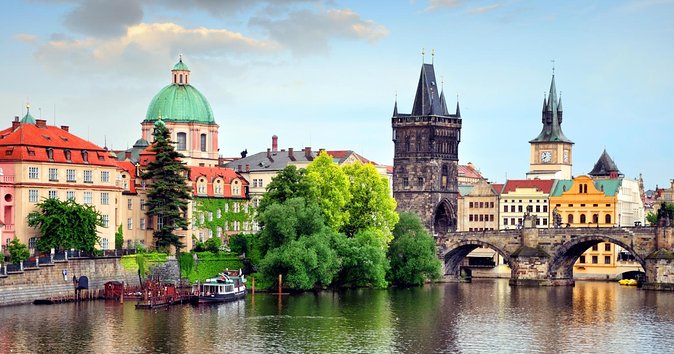
- Picture-perfect sequence: Art Nouveau at the Municipal House, Gothic at Powder Tower, then Charles Bridge panoramas
- Astronomical Clock, explained hour-by-hour: you’ll understand what you’re seeing when the medieval show starts
- Jewish Quarter stops with specific context: Old-New Synagogue, Pinkas Synagogue, and the story tied to Jan Palach
- Cubist Prague and Mozart connections: Charles University, Wenceslas Square, and the Estates Theatre link culture to place
Entering Old Town with a guide who actually changes your day
Prague can feel like two things at once: gorgeous and overwhelming. This tour helps because it’s built as a tight, guided circuit through the most important parts of Prague’s center—Old Town, the Jewish Quarter, and the approach to Charles Bridge—without sending you off on random solo errands.
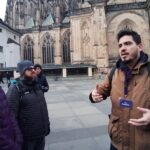
The big win is the private format. In a group tour, you often get stuck where the crowd is thickest and where the schedule says you should be. With this one, the guide can shape your time around your interests, which is exactly what makes the stops land. Some standout guides associated with this operator—Linda, Tereza, Jana, Katy, and Nina—are repeatedly praised for being friendly while still keeping the facts straight, and for sprinkling in personal stories that make the city feel like a real place, not a slideshow.
Yes, it’s still a walking tour. But the route is designed to keep you moving along coherent neighborhoods and landmarks instead of bouncing around town. For you, that means less confusion, fewer wrong turns, and more time to look up.
You can also read our reviews of more private tours in Prague



Municipal House to Powder Tower: Art Nouveau meets the medieval gate
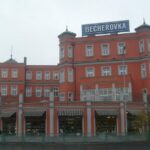
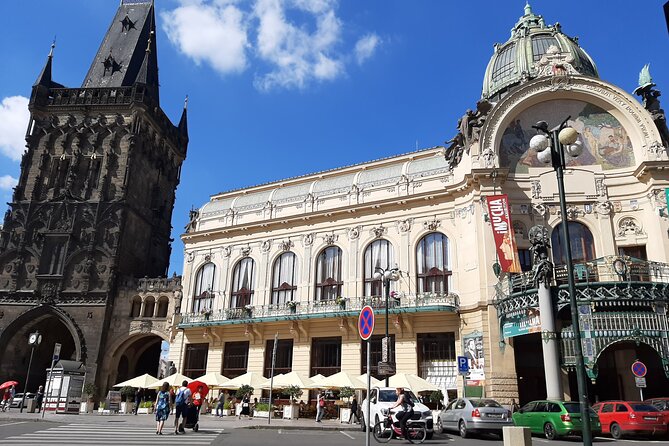
Your morning (or afternoon) starts with the Municipal House, a standout Art Nouveau building in the Old Town area. What I like about this stop is the contrast: it isn’t just pretty architecture. The building sits on a former royal residence site, and it’s also tied to major events—especially the proclamation of Czechoslovakia’s independence in 1918. That kind of detail turns a facade into a timeline you can actually feel.
From there, the tour pushes you toward the Powder Tower (Prasna brana), one of the defining late Gothic structures in the Old Town’s fortress line. It’s also useful historically: it’s the only preserved tower from medieval fortifications, and it functioned as an entrance into the Old Town. The guide’s job here is to give you the mental picture—what it meant for kings and emperors to pass through on their way to coronation at Prague Castle—so you understand why this tower matters beyond its postcard look.
A small practical thought: both the Municipal House area and the Powder Tower zone are excellent for photos, but they can also be busy. If your guide offers a moment to reposition, take it. Prague photographs best when you control your angles.
Cubist House of the Black Madonna and the Estates Theatre: Prague’s art nerd side
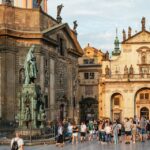
Prague has more than one “main style,” and this tour makes sure you see that. One stop is the House of the Black Madonna, considered a prime example of Cubist architecture. Today, the building works as a hub for visitors through a Cubist café and the Museum of Cubist Applied Arts. Even if you don’t go into the museum, the exterior helps you understand that Prague’s creativity wasn’t limited to Gothic churches and fairy-tale spires.
Next comes the Estates Theatre, a key cultural stop for music history. This is where Mozart performed the world premiere of Don Giovanni in 1787. The theatre is also connected to later pop culture: the famous film Amadeus used the place in the 1980s. The reason this works on a walking tour is simple. When you tie a famous composer and a famous movie to a real building you can stand in front of, the story stops being vague.
If you’re the type who likes to connect art to real geography, these two stops are a highlight. They also help break up the heavier political and architectural pieces later in the Old Town loop.
Charles University, Wenceslas Square, and Havel’s Market: history with names and dates
Not every Prague tour spends time on the streets that connect the big monuments. This one does. Charles University is a good example. Founded by Charles IV in 1348, it’s among Europe’s oldest universities and also the oldest in the Czech Republic. The guide helps you connect the university to the wider idea of Prague as a long-running center of learning, not just tourism.
Then comes Wenceslas Square (Václavské náměstí), one of the country’s best-known squares. This is where the Velvet Revolution took place, marking the end of Communist rule in 1989. When you walk through spaces like this with context, the square becomes more than a wide avenue—it becomes a place with a turning point attached to it.
Havel’s Markets adds a different kind of energy. It’s been in operation since 1232. That’s a long time for a market to keep its role in a city. It’s the kind of stop that makes you realize the historic center isn’t just preserved; it’s still used.
One practical note: squares and main streets can be windier and more exposed. If you’re doing this in cooler months, bring something light you can layer.
Old Town Square and the Astronomical Clock’s hourly show
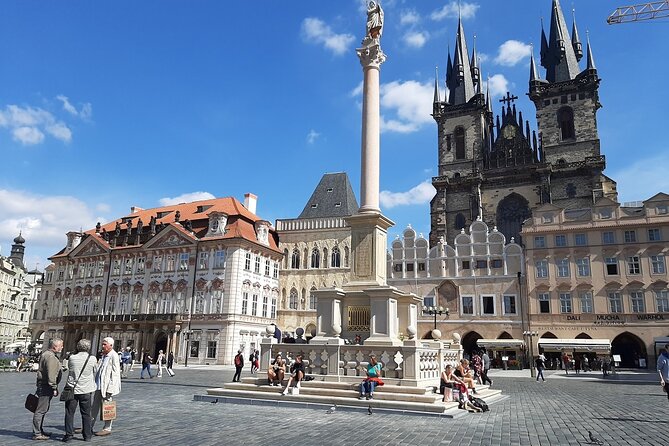
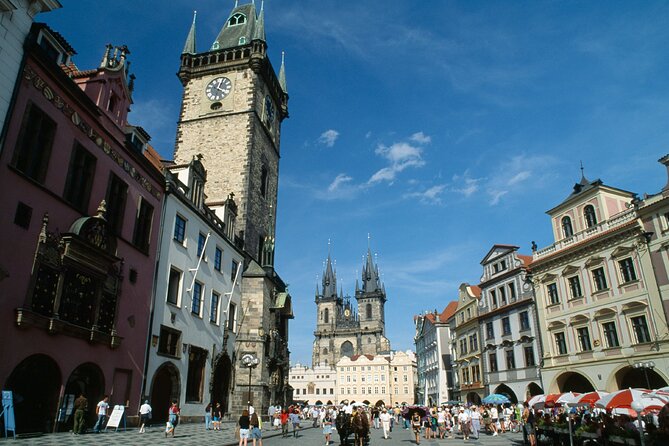
Old Town Square is the center of the center. It’s surrounded by historic palaces and churches, and it’s also tied to decisive events in the country’s story. You’ll understand quickly why this square is so famous when your guide points out the specific details that shaped how the city functioned over time.
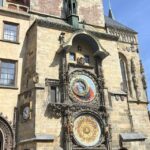
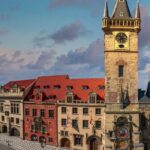
Then you get to the Astronomical Clock, the stop that usually pulls the biggest crowds. Here’s what matters for your experience: every hour on the hour, there’s a medieval show that draws visitors. The tour doesn’t treat the clock as a quick glance. Your guide explains how the Astronomical Clock works, so when the timing hits, you’re not standing there guessing.
That explanation is the difference between seeing a famous object and actually getting something out of it. You’ll also get a better sense of what you should watch for during the mechanical sequence—so the moment feels purposeful instead of chaotic.
If you’re sensitive to crowds, pick your viewing spot with care. The clock’s hourly timing means you’ll see a surge of people. Give yourself a few minutes to find a spot that isn’t blocked, and trust your guide to help you time it well.




Jewish Quarter essentials: Old-New Synagogue, Pinkas Synagogue, and Jan Palach
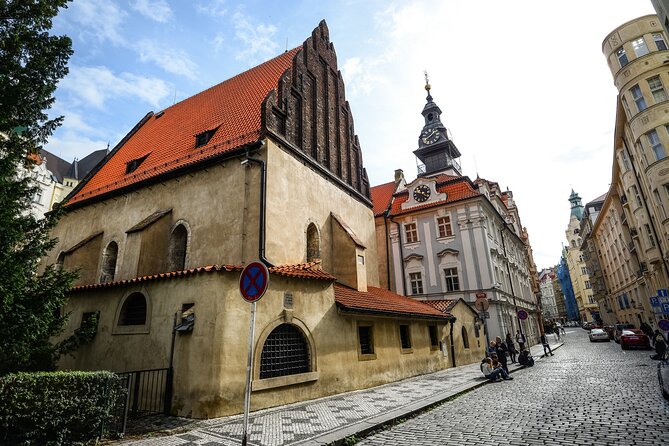
The Jewish Quarter section of this tour is where the tone deepens, and it’s handled with specific, meaningful stops. The Old-New Synagogue is one of the anchors. It’s the oldest preserved synagogue in Europe after the Second World War and one of Prague’s oldest Gothic buildings. That combination—survival through modern history plus deep architectural age—makes it powerful even before you absorb details.
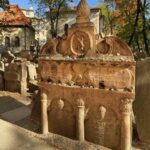
Next is the Pinkas Synagogue, part of the Jewish Museum in Prague. It also serves as an entrance to the Old Jewish Cemetery. Again, the value here is not just that you’re seeing a building; it’s that you’re getting the connective tissue between institutions, burial ground, and the way memory is preserved in physical space.
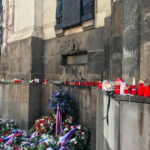
Then the tour includes a more recent historical marker: Jan Palach’s self-immolation. It was a political protest against the Warsaw Pact invasion of Czechoslovakia in 1968, which ended the democratic movement often linked to Prague Spring. It’s the kind of stop that many visitors walk past without context. With a guide, the meaning becomes clear and the timeline clicks.
This part of the route is also a good reminder that Prague isn’t frozen in time. It’s a city layered with centuries of belief, hardship, and change—and those layers show up right where you’re standing.
Klementinum and Charles Bridge: books, towers, and city panoramas
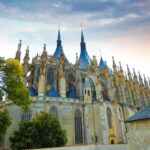
After the Jewish Quarter, the tour shifts toward the city’s enduring intellectual and visual pull. The Klementinum, founded as a Jesuit college, is home to the National Library. The stop is about more than a grand building. It’s a place where you find valuable book collections, tied to the idea that Prague has long treated learning as a civic identity.
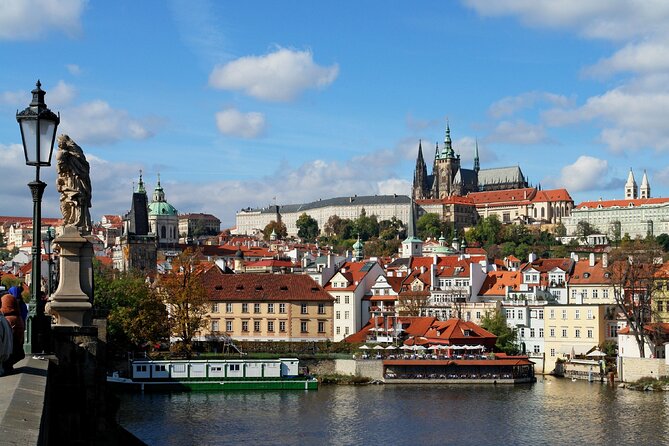
Finally, you reach Charles Bridge. Built in 1357 as a Gothic bridge, it’s one of the most beautiful sights in Prague for a reason: the views. Your guide helps you see the bridge as a viewpoint and as a historic connector, not just a crossing.
Charles Bridge is often a crush of people. That’s normal. What you can control is how you experience it. When you understand the bridge’s age and role, the walk feels different. You stop thinking of it as a tourist bottleneck and start treating it like a historic route you’re lucky to be on.
This is a great finish because it gives you a payoff: sights that are easy to remember later, photos that actually capture the city, and a sense that you’ve walked across more than one era.
Price and logistics: is $134.86 per person worth it?
At $134.86 per person for about 3 hours, this is priced in the private-tour lane. The question isn’t whether it’s cheaper than doing it solo (it won’t be). The question is whether it saves you time and confusion.
Here’s what you’re paying for:
- A licensed, local guide who knows how to connect the dots across Old Town, the Jewish Quarter, and Charles Bridge
- Pickup offered, either at your hotel reception/outside your apartment building or via a meet-up at the Municipal House entrance (Obecni dum, Namesti Republiky 5, Stare mesto)
- Time saved from planning: the route hits major points you’d otherwise have to sequence yourself
- Optional add-ons: admission isn’t included across the board, but if you want it, you can buy it on the spot by card
- Small extras that matter: restaurant and photo spot recommendations, plus the tour includes ongoing charity support for local children’s homes
In plain terms: if you’re short on time and you want the history stitched together in a way that’s easy to follow, the price usually feels fair. If you’re a confident self-guided traveler who loves turning your day into a DIY puzzle, you might not need a private guide.
How to plan your day for the best experience
A walking tour that hits these landmarks works best when you respect three realities: you’ll walk a lot, some spots are crowd magnets, and a few stops may tempt you into optional entry.
So, I’d do this:
- Wear comfortable shoes. Old Town streets are not designed for stiff posture.
- Bring a card for optional admissions on the spot.
- Expect the Astronomical Clock area to get busy around the hour. Build patience into your plan and don’t rush your viewing spot.
- If you want photos at Powder Tower, Old Town Square, or Charles Bridge, ask your guide when the crowd thins for a moment of breathing space.
Also, since it’s offered in English and your guide can adjust pace, tell them what you care about. If your top priorities are Jewish history, architecture, or the Mozart link, say it early. That’s when you’ll feel the private advantage most.
Who this private Prague tour is best for
This tour fits best if you want a focused, guided walkthrough of Prague’s must-see center without turning your day into logistics.
It’s especially good for:
- Couples and small groups who want flexibility and fewer crowd frustrations
- First-time Prague visitors who want the big highlights with real context
- Anyone who likes history that has dates attached—1918, 1348, 1232, 1989, 1968
- Music and architecture fans who care about Mozart, Cubism, and Gothic details
It may be less ideal if:
- You dislike standing for timed moments like the Astronomical Clock show
- Your group expects a lot of sitting down and long stays at one stop
Should you book the Prague Old Town, Jewish Quarter and Charles Bridge Private Tour?
I’d book it if you want the highlights—Municipal House, Astronomical Clock, Old-New Synagogue, Pinkas Synagogue, and Charles Bridge—stitched into one smooth walk with a guide who can shift pace and answer your questions. The private format and the guide’s ability to explain what you’re seeing make it more than a sightseeing circuit.
If you do the opposite—skip a guide and just wander—you might still see all the places. But you’re more likely to miss the connections that make Prague feel like a living story.
FAQ
Is this tour private?
Yes. It’s a private tour/activity, and only your group will participate.
How long is the Prague Old Town, Jewish Quarter and Charles Bridge private tour?
The tour runs about 3 hours.
Is hotel pickup available?
Yes. Pickup is offered at your hotel reception or outside of your apartment building. If you prefer to meet in Old Town, you can meet at the entrance to the Municipal House (Obecni dum, Namesti Republiky 5, Stare mesto).
Is the tour offered in English?
Yes, the tour is offered in English.
Are entrance tickets included?
Admission is optional. If you want to enter specific sites, you can buy admission on the spot by card.
Is free cancellation available?
Yes. You can cancel up to 24 hours in advance for a full refund.