REVIEW · PRAGUE
2-Hour Old Town and Jewish Quarter Tour in Prague
Book on Viator →Operated by Guides&Tours · Bookable on Viator
Prague’s Old Town moves fast. This 2-hour guided walk strings together the Astronomical Clock area and the Jewish Quarter (Josefov) without the hassle of long museum lines. It is built for people who want the big stories and the right street-level landmarks.
I especially like how the route balances iconic sights with less-expected stops like Týn Yard and the story behind the name Ungelt. I also like the pace: enough time to look, and enough guidance to make what you see actually mean something.
One thing to consider: the tour generally keeps you outside at the clock and the synagogues, so if you want to go inside and linger for a long time, you may want a separate ticket-based visit.
In This Review
- Key things to notice before you go
- 2 Hours Covering Old Town + Josefov in a Small Group
- Meeting Point at Staroměstská radnice: Getting Your Bearings Fast
- Outside the Astronomical Clock: The Story Behind the Most Famous Face
- Staroměstské náměstí: Where Prague’s Power Shows Up in Stone
- Týn Yard and Ungelt: A Merchant’s Yard Name You’ll Remember
- Josefov From the Street: Synagogues You See, Without the Crowds Inside
- Spanish Synagogue: The Youngest Major Synagogue in the Set
- Old-New Synagogue: One of Central Europe’s Oldest
- Pinkas Synagogue: The Quarter’s Feel Hits You Here
- Maisel Synagogue: Renaissance Reconstruction Funded Locally
- From Parizska Street to Rudolfinum: Two Prague Moods in One Route
- Parizska Street: Luxury Avenue, Straight and Bright
- Rudolfinum: A Concert Hall with Dvořák in the Backstory
- Price, Group Size, and the Real Value of Seeing Without Entering
- Timing, Walking Comfort, and Winter Cold Reality
- Who Should Book This Tour (and Who Might Want Something Else)
- Should You Book? My Take on the Best Use of This 2-Hour Route
- FAQ
- Is admission included for the Astronomical Clock or the synagogues?
- Does the tour enter the attractions, or is it outside viewing?
- How long is the tour?
- What language is the tour offered in?
- Where do I meet and where does it end?
- How big is the group?
Key things to notice before you go
- A licensed guide and strong narrative: you get context, not just a checklist of sights
- Outside viewing at major stops: quicker, easier, and light on ticket logistics
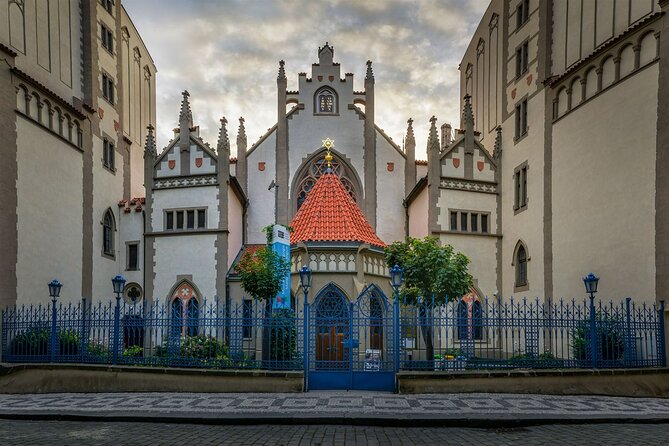
- Jewish Quarter highlights in Josefov: Spanish Synagogue, Old-New Synagogue, Pinkas Synagogue, and Maisel Synagogue from the street
- Old Town fundamentals: Staroměstské náměstí and the Astronomical Clock zone anchor the walk
- Small-group feel: capped at 20 travelers, so it feels manageable
- A tightly timed 2-hour loop: multiple stops with short viewing windows means you’ll need comfy shoes
2 Hours Covering Old Town + Josefov in a Small Group
If you only have a short window in Prague, this kind of tour is a smart move. In about two hours, you get your bearings in the Old Town and then shift into Josefov, the Jewish Quarter area where centuries of life and change can be hard to decode on your own.
What makes this one work is the mix of famous landmarks and practical stops. You’ll spend enough time at each place to look closely, but you won’t get stuck in the kind of slow, wandering schedule that eats up your day. The group size is capped at 20, which matters in Prague’s tight historic streets. Smaller groups are easier to follow, and you waste less time waiting for someone to catch up.
The biggest trade-off is also simple. Several of the headline sights are viewed from the outside, not entered. That keeps the tour moving and removes some ticket friction, but you should plan your expectations accordingly—this is a story-first walk, not a museum marathon.
You can also read our reviews of more tours and experiences in Prague


Meeting Point at Staroměstská radnice: Getting Your Bearings Fast
Most people start feeling lost in Prague right around the moment they reach Old Town’s busiest core. The meeting point here—Staroměstská radnice, Staroměstské nám. 1/3—puts you right where the action is, near the Astronomical Clock zone and the main square.
From the first minutes, you can orient yourself. You know where you are, and you start to connect street names with landmarks. That is one of the quiet benefits of a guided loop: you stop “collecting photos” and start collecting reference points.
The tour ends at Jan Palach Square, which is also useful. It’s a handy finish point when you want to keep exploring afterward on your own without backtracking.
Outside the Astronomical Clock: The Story Behind the Most Famous Face
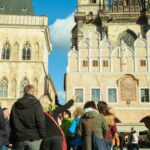
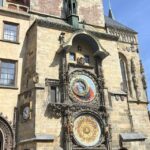
The first formal stop is at the Old Town Hall with the Astronomical Clock area. Here, you get time to admire the famous clock and hear the explanation from an official licensed guide.
Important detail: this tour does not enter the attraction. You stay outside and focus on the setting and the story. That is actually a good fit for many visitors. The Astronomical Clock can lure you into spending 45 minutes standing there without understanding what you are looking at. With this format, you can enjoy the view and the meaning, then move on.
You get around 15 minutes for this stop. That is a good amount of time for looking at the clock from the square, absorbing what the guide explains, and still keeping pace for the rest of the Jewish Quarter. If you tend to freeze in front of landmarks, you’ll still be able to enjoy the day without falling behind.
One practical note: in tight historic squares, sound can be an issue. One piece of feedback you may relate to is the wish for clearer audio. If you’re sensitive to that, try to position yourself where you can hear well—don’t stand all the way at the edge of the group.
Staroměstské náměstí: Where Prague’s Power Shows Up in Stone
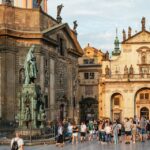
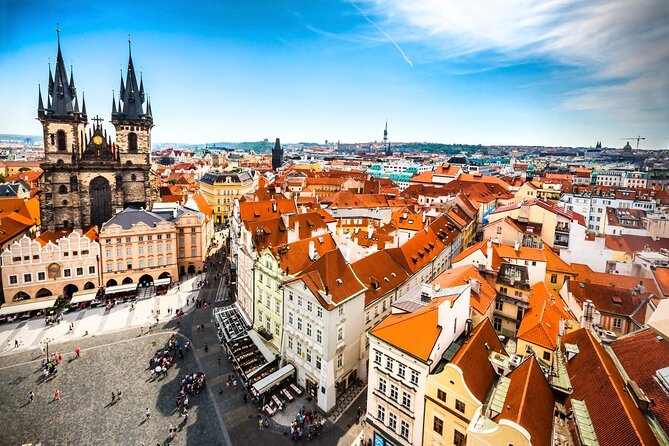
From the Old Town Hall area, you’ll walk to Staroměstské náměstí, the main historic square of Old Town. This is where Prague’s city identity becomes visible fast: grand facades, public spaces shaped by centuries, and the kind of geometry that makes the city feel designed, not accidental.
This stop is also about time and perspective. You’re given 15 minutes, which is enough to read the space with your eyes. The square traces back to the 12th century, and it has been witness to many major events. The guide helps you connect the square to those events, so it doesn’t feel like just another pretty plaza.
Admission here is free, so you’re not paying to understand the space. You’re using a guided lens to make the square feel less like scenery and more like context.
Týn Yard and Ungelt: A Merchant’s Yard Name You’ll Remember
Then you shift from the broad square into a more compact historic block: Týn Yard – Ungelt. This is the kind of stop I love because it’s not the headline sight, but it makes the city’s past feel real.
You’ll get a quick explanation of where the name Ungelt comes from. The idea is that this area was tied to merchants and customs—specifically, duties (the concept behind the name) collected there.
Historically, places like this were the in-between parts of city life that make trade and daily survival work. On your own, it’s easy to walk past without noticing. With a guide, the same buildings start to feel like a functioning system, not a random collection of old facades.
This one is only about 10 minutes, but it’s a solid “pause and notice” stop. If you like learning how cities actually ran, you’ll appreciate it.




Josefov From the Street: Synagogues You See, Without the Crowds Inside
After Old Town’s main spaces, the tour enters Josefov, and that part is the emotional core for many visitors. Instead of trying to fit multiple indoor visits into a short timeframe, you’ll admire several major synagogue buildings from outside.
This matters for two reasons:
1) You avoid the time sink of ticketed entry and line management.
2) You can keep the rhythm of the walk and still get the big cultural context from the guide.
Here’s what you’ll see, and what it means.
Spanish Synagogue: The Youngest Major Synagogue in the Set
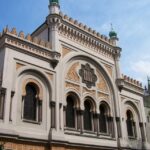
You’ll stop at the Spanish Synagogue and Jewish Museum area. The tour notes that the building you’ll see is the youngest and described as the most beautiful synagogue of the Jewish Town in Prague’s Josefov district.
You won’t enter here either. You stay outside for about 15 minutes. That’s a good time window: you can look at the building, absorb what the guide explains, and then keep moving deeper into the Quarter.
For many visitors, this stop is a confidence builder. Josefov can look like a cluster of historic structures from the outside. Naming the building and framing its place in the district helps you understand what you’re looking at.
Old-New Synagogue: One of Central Europe’s Oldest
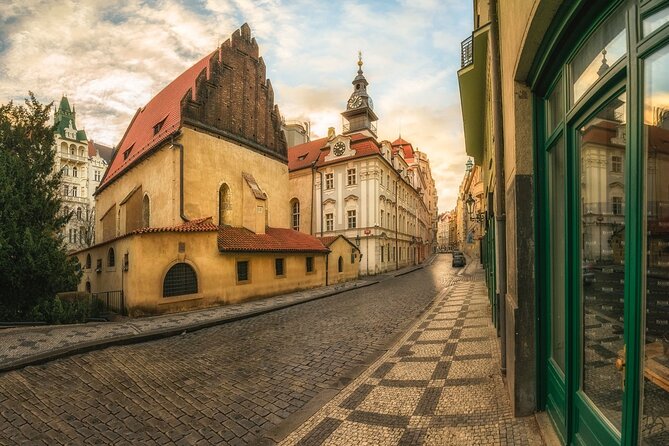
Next is the Old-New Synagogue. The description given is big: it is among the oldest and most valuable Jewish monuments in Europe, and it is the oldest synagogue in Central Europe.
Again, you do not enter. This is outside viewing for around 15 minutes, with the guide explaining what happened inside. That approach can still be satisfying. Even if you don’t go in, you get the building’s role and significance, which is often what helps people connect emotionally to historic sites.
This is also one of the stops where I’d expect many people to slow down. When a place is that old, the street-level view can feel like you are standing beside a long chain of life. Outside viewing won’t give you every detail, but it can still leave a strong impression.
Pinkas Synagogue: The Quarter’s Feel Hits You Here
Then the tour brings you to Pinkas Synagogue, giving you a broader sense of the Jewish Quarter of Prague. You’ll see the synchronic lineup of sites—Pinkas Synagogue, Old-New Synagogue, Spanish Synagogue, and Maisel Synagogue—as part of how the district connects.
The format again is outside, about 15 minutes, with the guide setting the scene so you can see more than just one building at a time.
This is the moment where the walking tour becomes more than sightseeing. With the different synagogue facades and the guide’s framing, the Quarter starts to feel like a place with identity, not just a stop on a route.
Maisel Synagogue: Renaissance Reconstruction Funded Locally
Finally, you’ll reach Maisel Synagogue. This stop has a clear, specific story: it was built from 1590 to 1592 by Mordechai Maisel, the mayor of the Jewish Town, and he funded the Renaissance reconstruction of the ghetto.
Outside for about 15 minutes, this is a strong example of why guidance matters. If you just see an old building, it might register as architecture. If someone explains who funded and rebuilt it, it turns into a snapshot of community power and resilience.
And that is a theme you’ll feel in Josefov: the Quarter’s history isn’t only about loss. It’s also about institutions, rebuilding, and survival.
From Parizska Street to Rudolfinum: Two Prague Moods in One Route
After Josefov, the walk shifts again—this time toward a different kind of Prague identity.
Parizska Street: Luxury Avenue, Straight and Bright
You’ll stroll along Parizska Street, described as Prague’s most prestigious boulevard with luxury boutiques and high-fashion brands. The stop is only about 10 minutes, and it’s free.
This is not a “buying” stop, unless you want it to be. It’s more like a palate cleanser. Old Town and Josefov can pull you into centuries of context. Parizska Street gives you a modern edge and helps you see Prague as a living city, not a preserved postcard.
Rudolfinum: A Concert Hall with Dvořák in the Backstory
Then comes Rudolfinum, Prague’s prestigious concert hall and home of the Czech Philharmonic. You’ll hear about the Neo-Renaissance building and an early historic performance connection from 1896 under Antonín Dvořák.
This stop is about 10 minutes, and again you stay outside. While you aren’t going inside, the guide helps you place the building in the timeline of Prague’s cultural life.
If you love music, this stop can act like a bonus prompt. Even without entry, it might make you want to check what’s on later that day or evening.
Price, Group Size, and the Real Value of Seeing Without Entering
The price is $30.25 per person for an approx. 2-hour guided experience. At this cost, what you’re really paying for is not entry fees—it’s the guide’s narrative and the way the route is packed into a short time slot.
Admission isn’t included for several key sights you view from outside: the Astronomical Clock attraction area and multiple synagogues. Some stops are free, like Staroměstské náměstí and Týn Yard – Ungelt.
So, is it good value? For many visitors, yes—because you get:
- a tight Old Town and Josefov orientation
- short, clear explanations at each major site
- a small-group experience limited to 20 travelers
- a route that avoids indoor logistics while still giving the meaning behind the monuments
If you’re the type who wants to go inside multiple historic buildings, you may end up doing extra ticketed visits anyway. But if you want the context first, then decide what to enter later, this is an efficient way to plan your day.
Timing, Walking Comfort, and Winter Cold Reality
This tour is short, but it is still walking. You’ll cover a compact cluster of stops, then move between Old Town and Josefov streets, and then back toward the center for Parizska Street and Rudolfinum.
If you visit in colder months, plan for weather. One note that rings true for Prague in winter: you can end up standing outside in crowds at several stops. Dress warm, and don’t underestimate how quickly cold can sap your patience when you are waiting for a photo or listening for explanations.
Comfortable shoes matter most. The time windows are brief at each place, so if your feet hurt, you won’t enjoy the stories as much.
Also, build in mental flexibility. Short stops are great for staying efficient, but it means you might not get a long, quiet moment at each location. If you need slow and solitary, consider adding extra self-guided time later.
Who Should Book This Tour (and Who Might Want Something Else)
This tour is a great fit if:
- you want structure in Old Town and Josefov
- you like guided storytelling that helps you interpret buildings
- you prefer a small group over large bus crowds
- you have limited time and want a well-paced loop
It may be less ideal if:
- you strongly prefer indoor visits at major sites
- you want long stays inside museums or synagogues
- you dislike walking and would rather sit through a slower-paced experience
For many travelers, the best strategy is to treat this as your “orientation and context” tour. Then, based on what you liked most—whether it was Josefov’s architecture or Old Town’s main square—you can decide where to return with your own time and tickets.
Should You Book? My Take on the Best Use of This 2-Hour Route
I’d book this tour if you want the Prague highlights in a compact package with a guide who helps you connect what you see to what it means. The biggest reason is the format: you get multiple major Jewish Quarter landmarks and the central Old Town anchors in just two hours, while staying outside and keeping the day moving.
If your priorities include indoor exploration, plan to add separate visits to any synagogues or attractions you want to enter. But as a first pass—especially if you’re new to Prague or want a calm, guided way to understand Josefov—it’s an easy yes.
FAQ
Is admission included for the Astronomical Clock or the synagogues?
No. The stops that relate to the Astronomical Clock and several synagogues are marked as not including admission. Some other stops on the route are free.
Does the tour enter the attractions, or is it outside viewing?
The tour notes that for key sites like the Astronomical Clock and the synagogues, you will stay outside and not enter the attractions.
How long is the tour?
It runs for approximately 2 hours.
What language is the tour offered in?
The tour is offered in English.
Where do I meet and where does it end?
You start at Staroměstská radnice on Staré Město and end at Jan Palach Square.
How big is the group?
The tour has a maximum of 20 travelers.