REVIEW · PRAGUE
Prague Essential Tour Old Town and Jewish Quarter
Book on Viator →Operated by Verneus Tours - Free Tour Praga · Bookable on Viator
Two hours can teach you a whole city.
This Prague Old Town and Jewish Quarter walk is built for fast understanding: you get landmark-by-landmark context for how Prague grew, changed, and kept telling its stories. I love how the guide starts you at a clear meeting spot and uses each stop to connect history to what you’re actually seeing, especially around Staroměstské náměstí and the synagogue area. The route also keeps moving so you’re not stuck in one place, even though several sights are major crowd magnets.
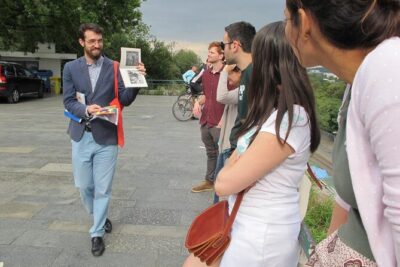
What I really like is the guide format: a certified official guide with an approach that turns famous buildings into real-world clues. You’ll hear why the skyline looks the way it does, what makes the Astronomical Clock more than decoration, and why these Jewish landmarks matter in Prague’s broader story. The group stays small (up to 25), which helps you ask questions when things get confusing.
One possible drawback: the stops are short—often around 10 to 20 minutes—so if you want to linger long inside a single place, you’ll likely want to come back later on your own. Also, two moments note admission not included, so check ahead if you plan to go inside those specific spots.
In This Review
- Key things to know before you go
- Rudolfinum to Old Town Square: the tour’s smart warm-up
- St. Nicholas to Týn Church: how Prague’s skyline makes sense
- Old Town Hall and the Astronomical Clock: what you’re really looking at
- Karolinum and the Estates Theatre: Prague beyond churches
- Powder Tower to Kafka: from medieval gates to modern literature
- Spanish Synagogue and Old-New Synagogue: architecture with real purpose
- Old Jewish Cemetery: reading history through the leaning stones
- Price and timing: value for first-time Prague days
- Who should book this tour
- Should you book this Prague Essential Old Town and Jewish Quarter tour?
- FAQ
- Where is the meeting point for the tour?
- How long is the tour?
- Is the tour offered in English?
- What is included in the price?
- Are tickets or admissions included for all stops?
- How many people are in the group?
Key things to know before you go
- Easy start at Rudolfinum with visible white and green umbrellas so you can spot your guide fast
- Old Town Square orientation that explains the big names: St. Nicholas Church, Jan Hus, and the Town Hall vibe
- Astronomical Clock context so you know what you’re watching, not just what time it says
- University + arts stops with Karolinum and the Estates Theatre, including Mozart’s Don Giovanni (1787)
- Jewish Quarter landmarks in sequence from Kafka’s statue to the Spanish Synagogue and Old-New Synagogue
- Small group feel with a maximum of 25 people and a tour in English
Rudolfinum to Old Town Square: the tour’s smart warm-up
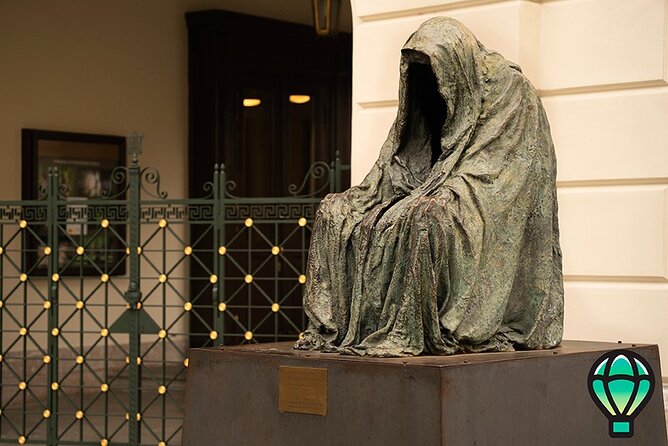
Most Prague walks start in the middle of noise. This one starts where you can breathe for a moment: the steps of Rudolfinum, a great meeting point with white and green umbrellas that make the group easy to find. That matters more than you’d think in the Old Town area, where streets can feel like a maze and “meeting points” can be vague.
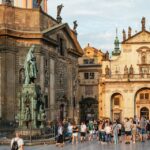
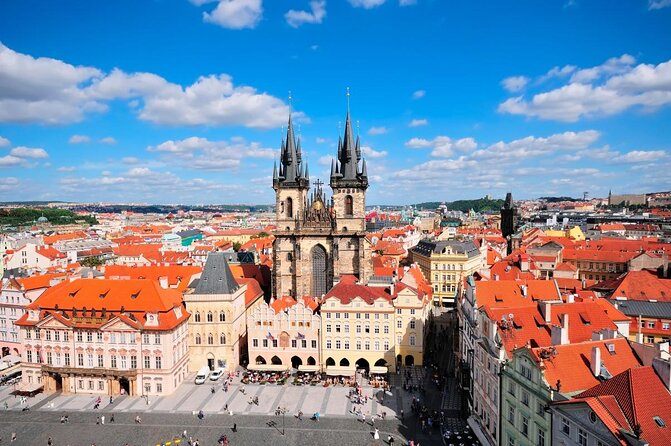
From there, you step into the core of the Old Town experience at Staroměstské náměstí (Old Town Square). This is the kind of place where it’s tempting to just take photos and move on. Instead, the guide gives you a simple framework: look at the buildings and identify the styles, then attach those styles to the people and eras that shaped them. You’ll hear references tied to major sights like the Baroque St. Nicholas Church, the Jan Hus sculpture, and the Gothic Town Hall—so the square stops being a postcard and starts becoming a timeline you can read with your eyes.
A practical tip here: because the tour is built around short stops, you’ll get the most out of it if you’re ready to look up while you’re standing still. Many of these details are vertical—spires, facades, sculptural elements—so don’t spend the first minute with your phone in your lap.
You can also read our reviews of more tours and experiences in Prague.


St. Nicholas to Týn Church: how Prague’s skyline makes sense
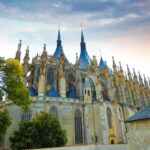
After Old Town Square, you move toward the Church of Our Lady before Týn. This is one of those Prague sights you recognize from postcards, but the guide helps you see it as an actual landmark with a reason to exist in that skyline. The focus is the Gothic look—especially the twin towers and the ornate facade that helps this church claim space above the rooftops.
Why this stop works: it gives you a mental map. Once you understand where the towers sit and why they’re so visually dominant, the rest of your day in Prague becomes easier. Streets turn from confusing corridors into routes you can follow, because your brain has reference points.
The time here is brief, so if you’re the kind of person who needs a few extra minutes to absorb architecture, treat this as a quick “okay, I get it” stop. You can always return later. But for first-time visitors, this is an efficient way to learn the city’s visual language without getting stuck reading guidebooks all day.
Old Town Hall and the Astronomical Clock: what you’re really looking at
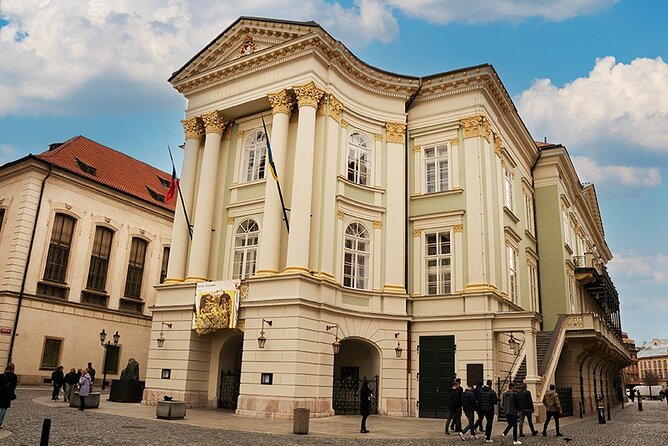
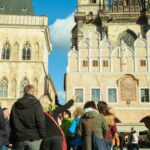
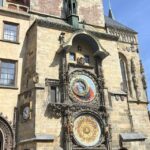
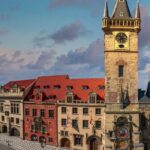
Next comes the big one: the Old Town Hall and the Astronomical Clock. It’s famous, sure. But famous doesn’t automatically mean you understand it. What’s useful on this tour is the explanation of what the clock actually shows—time is only part of the story. You also learn about the movement of the stars and other surprises connected with the clock’s medieval design.
This is exactly where a good guide pays off. Without context, the crowd gathers, the mechanism performs, and you leave thinking you saw something cool. With context, you leave thinking you understood something. The clock becomes a snapshot of how people once pictured the sky and time—less like a modern wristwatch, more like a medieval model of the universe.
Timing matters because there’s usually a crush around the clock. The tour keeps it moving, so you’re not waiting forever, but you also aren’t getting a long, sit-down lesson. If you want a calmer moment, I’d treat the clock viewing as your “official moment,” then plan to do a separate self-paced return later that day or the next morning.
Karolinum and the Estates Theatre: Prague beyond churches
Old Town and the Jewish Quarter could easily swallow an entire day. This tour adds something important: the academic and theatrical Prague side.
First up is Karolinum, linked with the University of Carlos. The big takeaway isn’t just that it’s old—it’s that it’s described as the oldest university in Central Europe. Even better, the tour ties the university to famous names you likely recognize: Kafka, Tesla, and Einstein. That’s a clever way to make a campus building feel relevant, not just historical.
Then you move to the Estates Theatre, known for major performances tied to the arts. The standout fact here is that Mozart premiered Don Giovanni in 1787 at this theatre. That’s the kind of detail that makes Prague feel bigger than its tourist circuits. You start noticing how often the city’s famous people overlap with the places you’re walking past.
One consideration: admission isn’t included for the Rudolfinum start and the Estates Theatre stop. So if your plan is to step inside both, you should expect a little extra cost or adjust expectations. The good news is that the tour is still valuable even if you keep those moments as exterior or brief viewing stops.
Powder Tower to Kafka: from medieval gates to modern literature
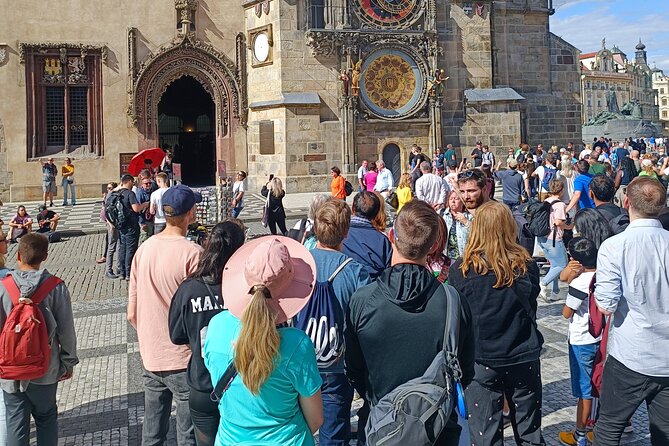
The next shift is to Mihulka Powder Tower, a medieval tower that used to function as one of the city’s entrance gates. Prague loves layers—old walls, newer streets, and new meanings for the same stones. This stop helps you connect what you’re seeing to the city’s older boundaries and how the urban map changed over time.
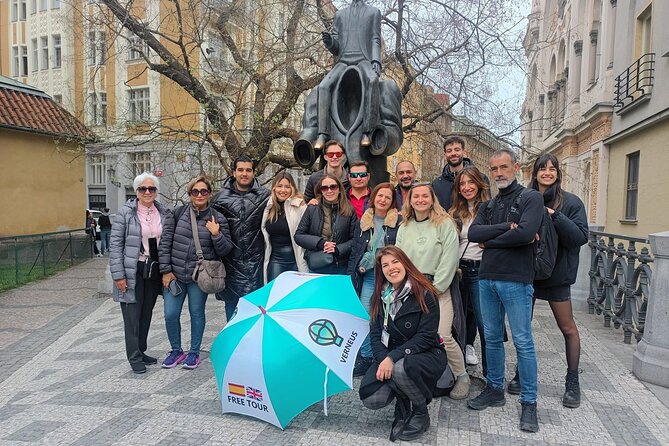
Then you’ll hit a landmark that feels like it belongs to a different kind of Prague: the Franz Kafka statue, placed right at the gates of the old Jewish quarter. It’s a small stop, but it’s powerful because it connects the neighborhood to one of the most influential writers of the 20th century. The guide’s framing makes the statue more than a photo spot; it becomes a hinge between literature and place.
If you’re into walking tours that explain how stories travel through cities, this is one of the tour’s best rhythm shifts. You go from medieval infrastructure to a 20th-century voice, and you see how Prague turns history into living memory.



Spanish Synagogue and Old-New Synagogue: architecture with real purpose
Now you reach the Jewish Quarter stops, and this part is where the tour earns its name.
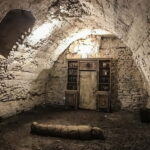
The first major building is the Spanish Synagogue, described as a beautiful architectural jewel built in Moorish style. The guide helps you notice the look and feel that makes it so distinctive compared to the Christian churches around Prague. It’s not just about being pretty; it’s about recognizing how different communities expressed identity through design.
Right after that, you’ll see the Old-New Synagogue, noted as one of the oldest synagogues in Europe that still preserves worship. The dating given is the 13th century, which is a wild concept when you’re standing in a city where so much feels like it was built yesterday. This is where you’ll likely slow down a bit, even if the scheduled time is short, because the age of the place can hit you like a physical fact.
What makes these synagogue stops especially valuable on a guided walk: you’re not just collecting names. You’re learning the relationship between architecture and continuity. Buildings like this don’t just represent a past—they keep communicating a living thread of community presence.
One practical note: admission is listed as free for these specific stops in the provided tour info. Still, synagogues and museum-like spaces can have rules, lines, and security checks, so keep some flexibility in your expectations and be ready to move quickly when the group needs to.
Old Jewish Cemetery: reading history through the leaning stones
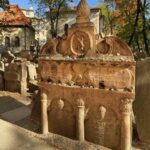
The last Jewish Quarter stop is the Old Jewish Cemetery, famous for a specific visual detail: tombstones that lean, creating a distinctive atmosphere. The time here is brief, but the point of the stop isn’t to be dramatic. It’s to show you how the neighborhood stores memory in a form you can’t fully replicate in a museum.
Cemeteries can feel heavy, so the best guided approach is usually simple: give you a few anchors for what you’re seeing and why it looks the way it does, then let you absorb the feeling. This is what helps many people find meaning quickly without turning it into a lecture.
If you’re visiting on a day when you’re also doing other Prague landmarks, consider lowering your pace at this stop. Don’t try to multitask. Look, breathe, and give the place a little respect. You’ll remember it longer than the buildings you rushed through.
Price and timing: value for first-time Prague days
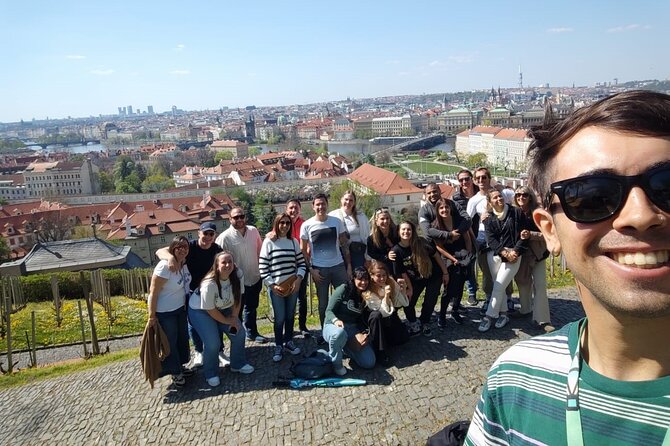
At $3.62 per person with a certified official guide, this tour is priced in a way that makes sense for travelers who want structure without paying a premium for it. Even if you’re on a tight budget, you’re buying one thing that’s hard to recreate on your own: guided interpretation that tells you what to notice while you’re standing in front of it.
The duration is about 2 hours 30 minutes, and the stop timing is designed for efficient coverage. That’s perfect if you’re meeting other plans later—dinner, a boat ride, or checking off another neighborhood. It’s also a good match for first-time visitors who don’t want to pick a few random landmarks and then miss the connections.
Language is English, and the group limit is 25 travelers, which usually helps keep the conversation from disappearing into the crowd noise. You’ll also have a mobile ticket, and the tour is near public transportation. That’s helpful in Prague, where walking is great, but transit can save you when your feet start complaining.
The main reason it’s good value is that you don’t just walk through “pretty places.” You get explanations that turn those places into a readable story: Old Town’s political and religious symbols, then the Jewish Quarter’s continuity, and finally the cultural links that connect famous people to the city streets.
Who should book this tour
This is a strong fit if you:
- Want a single, organized way to understand Old Town plus the Jewish Quarter in one stretch
- Prefer guided context over self-guided guessing
- Like a route that covers both architecture and stories (Mozart, Kafka, medieval clock mechanics)
- Appreciate a small group experience with a guide you can actually hear
You might want to plan something else or add extra time if you:
- Hate short viewing windows and want long museum-style stops
- Want to spend significant time inside every venue with no group pacing
- Are sensitive to crowd areas around major attractions like the clock
Should you book this Prague Essential Old Town and Jewish Quarter tour?
If you’re asking whether this is worth it, my answer is yes—with one condition: go in ready to learn quickly. This tour works best when you treat each stop like a chapter, not a whole book. The payoff is strong understanding in a short window, especially around the Astronomical Clock and the Jewish Quarter landmarks.
Also, the guide quality seems to be a standout theme. People mention guides such as Isaac, Lyle, and Dylan for making history feel understandable and for sharing fun, memorable facts rather than just reciting dates. That’s exactly what you want from a tour at this price.
Book it if you want a clear first pass through Prague’s core stories. Then, plan to return on your own to linger where you personally felt the pull.
FAQ
Where is the meeting point for the tour?
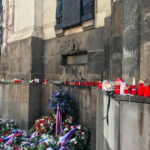
You meet at Jan Palach Squarenám. J. Palacha, 110 00 Praha 1-Staré Město, Czechia. The tour ends back at the meeting point.
How long is the tour?
The tour is approximately 2 hours 30 minutes.
Is the tour offered in English?
Yes. The tour is offered in English.
What is included in the price?
What’s included is a certified official guide and the 2:30 pm of entertainment (as listed by the tour). You also receive a mobile ticket.
Are tickets or admissions included for all stops?
No. The tour notes that admission tickets are not included for the Rudolfinum and the Estates Theatre stops. Other listed stops show admission ticket free.
How many people are in the group?
The tour has a maximum of 25 travelers.