REVIEW · PRAGUE
Prague Cold War Walking Tour
Book on Viator →Operated by Insight Cities · Bookable on Viator
Prague has secrets under its streets. This tour turns Prague into a Cold War classroom, led by a historian guide and built around Communist-era sites that explain how the system worked in real life. I especially love the small group size (max 8), because it makes room for questions, and the discussions stay thoughtful, not canned.
One thing to factor in: there’s a steep climb up Vitkov Hill (about 20 to 30 minutes uphill). If uphill walking is tough, you’ll likely want the alternative that skips Vitkov.
You’ll start near Náměstí Republiky, then follow a route designed to move from fear and control to public resistance. By the end, you’ll have a clearer sense of how Communism rose in Czechoslovakia and how the Velvet Revolution still echoes in today’s Prague.
In This Review
- Key things to know before you go
- Why this Cold War tour makes Prague make sense
- Your 3-hour arc: from bomb-shelter doors to Velvet Revolution sparks
- Stop 1: Pedestrian Tunnel Karlin-Zhizhkov
- Stop 2 and the big feature: Vitkov Hill’s monument complex
- Stop 4: Wenceslas Square as a history timeline in one place
- Vitkov Hill: Gottwald, the Soviet soldier hall, and why the climb matters
- National Monument at Vitkov
- Why this stop is worth the effort
- Zizkov TV tower, Wenceslas Square, and the politics of public space
- Prague TV tower on Zizkov Hill
- Wenceslas Square and the Velvet Revolution’s stagecraft
- Upside-Down statue of King Wenceslas
- Letna Hill, the Lennon Wall, and Communist echoes you can still feel
- Letna Hill and the Stalin statue story
- John Lennon Wall: political protest in handwriting
- National Assembly building: where Communist government sat
- Price and comfort: what your $126.43 buys you
- Should you book this Prague Cold War Walking Tour?
- FAQ
- How long is the Prague Cold War Walking Tour?
- What does the tour cost, and what’s included?
- Where does the tour start?
- Is the tour offered in English?
- What’s the group size?
- What are some key sites you’ll visit?
- Is food or drinks included?
- Is Vitkov Hill required?
- What is the cancellation policy?
Key things to know before you go
- Historian guide, English-led: you’re walking with a specialist mindset, not just a history storyteller.
- Max 8 people: small-group pacing helps you actually process what you’re seeing.
- Cold War fear and control in real space: from a pedestrian tunnel with locked bomb-shelter corridors to major monuments.
- Vitkov Hill is the workout stop: plan for an uphill climb and time at the monument complex.
- Wenceslas Square connects the dots: it’s treated as a timeline of power shifts, culminating in the Velvet Revolution.
- Politics in art form: the John Lennon Wall and the upside-down King Wenceslas sculpture give modern meaning to old propaganda.
Why this Cold War tour makes Prague make sense
Prague can look like a postcard until someone points out the hidden layer: what power wanted people to see, believe, and fear. This tour is built for that job. You’re not just getting names and dates—you’re walking between spaces that were designed for control, then ending at a place where resistance took over.
I like the way the tour treats ideology as something physical. You’ll see the statuary and decorations tied to Communist messaging, and you’ll hear how institutions shaped daily life. You also get the other half of the story: how the Velvet Revolution changed the direction, quickly, and why it still matters when you walk past the same streets today.
And yes, it’s a walking tour, so you’ll be moving through neighborhoods rather than bouncing around in a van. That matters. When you feel the geography—hills, squares, and viewpoints—the history lands with more weight.
You can also read our reviews of more walking tours in Prague

Your 3-hour arc: from bomb-shelter doors to Velvet Revolution sparks
Your tour runs about 3 hours, with a morning or afternoon departure you pick when you book. Meeting happens near Náměstí Republiky (Náměstí Republiky 1077/2), and the walk proper starts at St. Joseph Church.
The route is paced like an argument: first the machinery of fear, then the theater of Communism, and finally the public moment when things flipped.
Stop 1: Pedestrian Tunnel Karlin-Zhizhkov
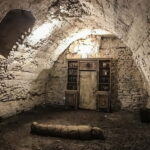
The walk begins with something quietly chilling: a pedestrian tunnel with locked doors that lead to Cold War nuclear bomb-shelter corridors. The doors are still kept in a way that suggests this was once treated as a real part of life, not just a movie set.
What I’d watch for here: the contrast. Prague is full of beautiful stone and old streets, but this tunnel is about contingency—how to protect leadership and infrastructure if the worst happened. It’s a strong opener because it sets the tone before you reach the major monuments.
Stop 2 and the big feature: Vitkov Hill’s monument complex
From there, the tour leans hard into Communist-era presence—especially at Vitkov Hill, where the views and the symbolism both do heavy lifting. Admission for the monument complex isn’t included, so think of this stop as the moment where your guide’s explanation really matters.
Along the way, you’ll also hear about Letna Hill, including the former site of an enormous Stalin statue—and the tragic story of the sculptor. That segment helps connect propaganda to the people who had to make it real.
Stop 4: Wenceslas Square as a history timeline in one place
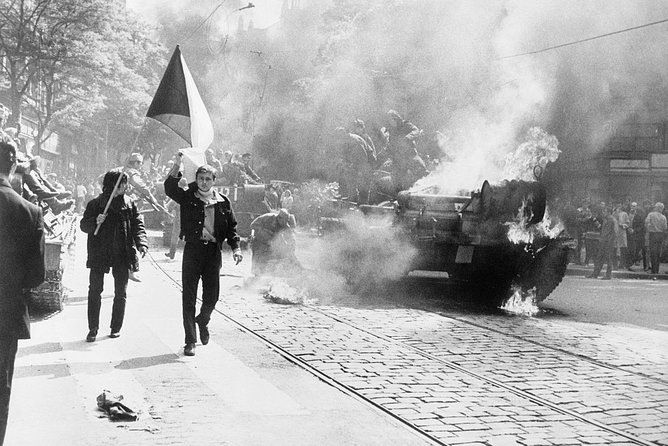
The final lead-in is Wenceslas Square, treated as a long timeline: from its 14th-century founding, through military parades under occupying powers, then the trauma of Prague Spring, and finally the explosive energy of the Velvet Revolution that ignited in a single day.
This is where the tour’s point becomes clear. You see why squares matter. They’re stages, and they decide who controls the story.

Vitkov Hill: Gottwald, the Soviet soldier hall, and why the climb matters
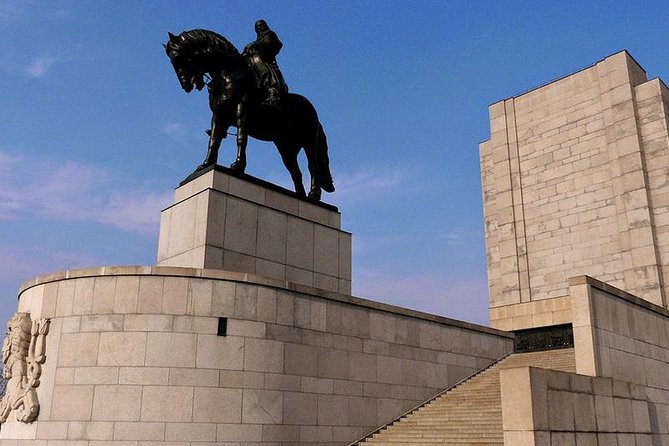
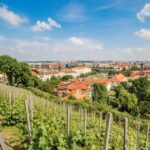
Vitkov is the tour’s physical and intellectual centerpiece. Plan for the uphill push: you’ll climb for about 20 to 30 minutes to reach the monument area. If you’re not comfortable with that, don’t grit your teeth and hope. The tour provider notes an option that can skip Vitkov for people with climbing difficulty.
National Monument at Vitkov
This monument isn’t just one building. It’s a complex with multiple layers of meaning:
- The Hall of the Soviet Soldier
This is where the Communist message becomes art and architecture. You’ll see distinctive statuary and decorations tied to Communist politics and propaganda.
- Klement Gottwald’s mausoleum and embalming laboratory
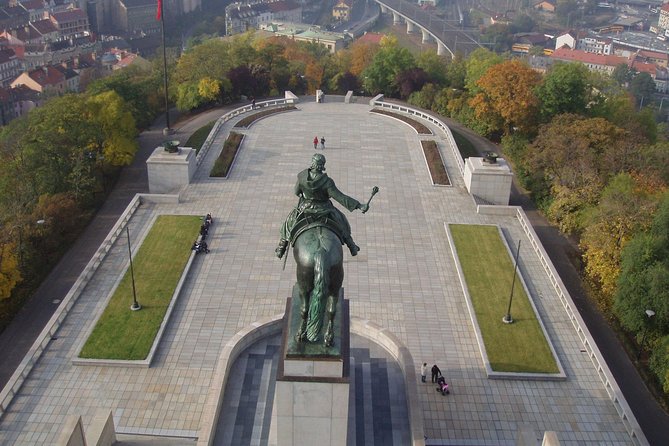
The tour includes a look at the mausoleum where the mummified corpse of Klement Gottwald was displayed, plus the adjoining laboratory where his body was embalmed. Even if you don’t love dark history, this is a striking reminder of how regimes tried to turn leaders into permanent icons.
- The giant equestrian statue of Jan Žižka
Vitkov also features one of the world’s biggest equestrian sculptures. The monument highlights Jan Žižka, described as the third largest bronze equestrian statue in the world. The symbolism is complicated here: national pride and Communist rule can overlap in odd ways, and your guide is there to untangle the messaging.
Why this stop is worth the effort
The climb is the tradeoff. When you’re up on Vitkov, you get the sense of oversight—how power liked to be seen, and how it wanted Prague to look different under Communism. If you only skim the surface, it’s just big concrete and big statues. With the historian-led framing, it becomes a map of intentions.
Practical note: tour admission for the monument complex isn’t included, so you’re paying for the guided experience, not the entry fee. That’s normal for city tours, but it’s worth knowing so there are no surprises when you’re standing at the doors.
Zizkov TV tower, Wenceslas Square, and the politics of public space
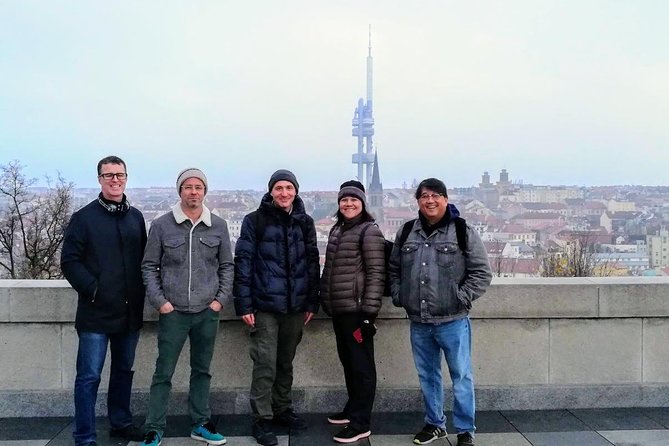
After the monument complex, the tour pivots to views and street-level meaning.
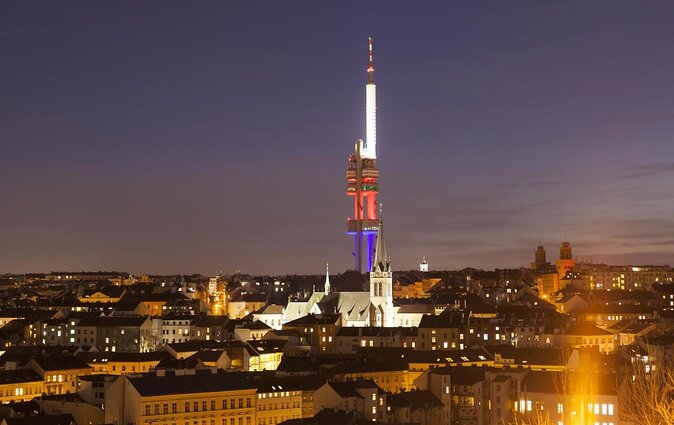
Prague TV tower on Zizkov Hill
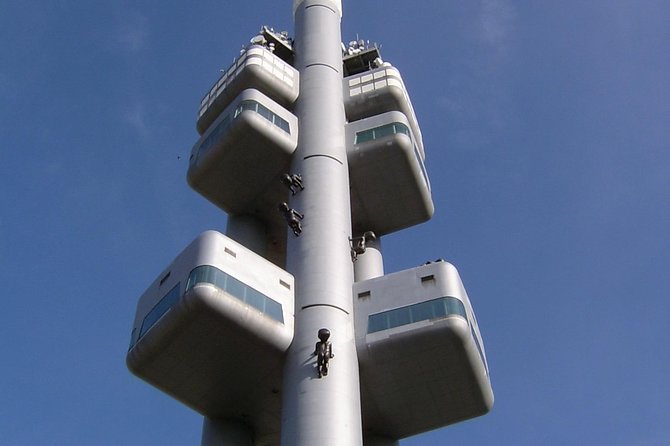
You’ll get a short stop for the Zizkov Television Tower, a standout example of Brutalist design. The tour frames this as a moment to shift gears: from Communist iconography to a more modern, Soviet-era style of engineering and visibility.
Even the brief time matters because you get a best-view type moment. It helps you orient the city while you keep learning. A good guide turns the skyline into another clue.
Wenceslas Square and the Velvet Revolution’s stagecraft
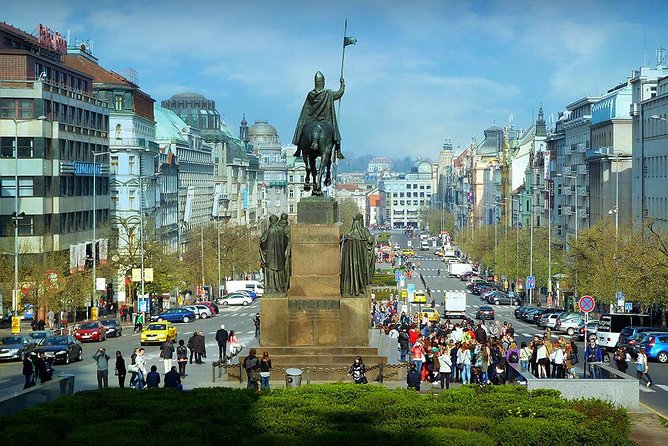
Wenceslas Square gets the most time after Vitkov—about 20 minutes—and your guide walks it like a timeline. Expect the square to be explained as a stage for different regimes: parades of occupying powers, the tense build-up around Prague Spring, and then the sudden eruption of the Velvet Revolution.
This is where you start connecting what you saw in monuments to what people did in public. Communism wasn’t only enforced by institutions. It was performed in public space, in ceremonies, and in how the city was arranged.
Upside-Down statue of King Wenceslas
Right after Wenceslas Square, you’ll also spot the ironic sculpture: the upside-down statue of King Wenceslas riding a dead horse. It’s short and punchy—about 5 minutes—but it’s the kind of artwork that makes you rethink the earlier imagery.
Think of it as a visual critique. When you’ve just been told about propaganda, this statue feels like the opposite message: power inverted, symbols treated with skepticism.
Letna Hill, the Lennon Wall, and Communist echoes you can still feel
The tour’s middle-to-late sections bring in protest and memory, not just monuments.
Letna Hill and the Stalin statue story
Letna Hill is where you hear how a giant statue can be both message and liability. You’ll learn about the former site of an enormous Stalin statue and the tragic story of its sculptor.
This part matters because it moves beyond ideology to the human cost of making ideology visible. It also shows why statues get taken down or reinterpreted: people aren’t only reacting to art. They’re reacting to the system that demanded it.
John Lennon Wall: political protest in handwriting
One of the tour’s most memorable stops is the John Lennon Wall, described as an important site of political protest. It’s a reminder that opposition doesn’t always look like uniforms and manifestos. Sometimes it looks like messages layered over time—quick, personal, and hard to erase.
In a tour that otherwise spends time with official power, the Lennon Wall is a pivot. You go from authoritarian symbols to grassroots speech.
National Assembly building: where Communist government sat
You’ll also pass the National Assembly building, framed as the seat of the Communist government. You won’t spend hours inside. But passing by a place like that with the right explanation gives you context for what you’re looking at—why a building’s function matters, even when the streets around it are now calmer.
The effect is cumulative. By the time you return to Wenceslas Square, you’re no longer asking only, Who ruled? You’re asking, How did rule work in daily life, and how did people break the script?
Price and comfort: what your $126.43 buys you
At $126.43 per person for about 3 hours, this isn’t a bargain bus tour. You’re paying for an experienced historian guide, a tight small-group format, and a route that includes city transit.
Here’s where the value comes from:
- Historian guide: this is the product. If you care about ideas—how propaganda functioned, how politics shifted, how Velvet Revolution changed the story—this is the right kind of tour.
- Small group (max 8): more room for questions, and fewer awkward moments when your pace doesn’t match a large group’s.
- Tram tickets included: you’re not stuck only on long stretches of walking, and that makes the 3-hour timing more realistic.
- Mobile ticket: less hassle on the day.
Also, book timing matters. This tour is often reserved far ahead (on average, about 195 days in advance). If you’re traveling in peak months, don’t wait for a last-minute impulse.
Comfort tip: bring something for uneven walking and weather. Even when the stops aren’t far apart, you’ll be climbing and standing. If you’re sensitive to uphill stretches, plan around Vitkov or look at the option that avoids it.
Should you book this Prague Cold War Walking Tour?
Book it if you want more than postcard Prague and you like history explained through places. This tour is built around the kind of details that make ideology feel real: bomb-shelter corridors, Communist memorial spaces, and protest sites that still read like warnings.
Skip or adjust if you know you can’t handle the Vitkov Hill climb. The provider explicitly flags that issue, and there’s an alternative that removes Vitkov for people with difficulty climbing.
If you’re the type who loves questions—why a statue was made, why a square mattered, why the Velvet Revolution landed where it did—this is one of the better value ways to get an organized, small-group education in Prague.
FAQ
How long is the Prague Cold War Walking Tour?
It runs about 3 hours.
What does the tour cost, and what’s included?
The price is $126.43 per person. The tour includes a historian guide and tram tickets.
Where does the tour start?
You meet at Náměstí Republiky 1077/2, Nové Město, 110 00 Praha-Praha 1, Czechia, and the walk begins at St. Joseph Church.
Is the tour offered in English?
Yes, it’s offered in English.
What’s the group size?
The tour has a maximum of 8 travelers.
What are some key sites you’ll visit?
You’ll pass or visit places such as the Karlin-Zhizhkov pedestrian tunnel, the National Monument at Vitkov, the Zizkov Television Tower viewpoint area, Wenceslas Square, the John Lennon Wall, and the Upside-Down statue of King Wenceslas riding a dead horse.
Is food or drinks included?
No. Food and drinks aren’t included.
Is Vitkov Hill required?
The tour includes a steep climb up Vitkov Hill. If you have difficulty climbing, the provider recommends a private tour that leaves out Vitkov.
What is the cancellation policy?
Free cancellation is available. You can cancel up to 24 hours in advance for a full refund. Any changes inside 24 hours aren’t accepted.